


Key Takeaways
Tech leads early gains on strong semiconductor outlook, Apple upgrade
Japan to report December CPI later today as interest rate decision looms
Investors mull latest housing data while awaiting tomorrow’s consumer sentiment reading
(Thursday market open) Selling pressure eased Thursday after the world’s largest chip builder issued a solid outlook and the world’s second-largest company received an upgrade.
The tech sector surged in premarket trading following Taiwan Semiconductor’s (TSM) earnings and forecast and an Apple (AAPL) upgrade from Bank of America. Taiwan Semiconductor—the main chip supplier to Apple and Nvidia (NVDA)—expects full-year revenue growth of at least 20%, jumpstarting hope that the chip sector could be in line for another big year after demand for artificial intelligence surged in 2023. Shares of the company climbed 7% ahead of Wall Street’s open.
“We will soon enter the quiet period ahead of the next Federal Reserve meeting, so the markets could be starting to stabilize and refocus on earnings, which are generally solid so far,” said Jeffrey Kleintop, chief global investment strategist at Schwab.
Yesterday offered fresh evidence that good economic news remains bad news, at least on Wall Street. A resilient December Retail Sales report helped ice major indexes as investors stepped back from once overwhelming expectations of a possible March interest rate cut.
While no one likes to wait, it can bring good things. Vigorous consumer spending, if it continues, could help ignite earnings growth in 2024 after a mediocre 2023. And while consumer prices rose more than expected last month, inflation remains far under year-ago levels. Strong consumers and lower inflation are two elements of the “soft landing” thesis, though it’s way too early to run a victory lap.
Real estate and utilities were among the weakest performers Wednesday. Both are vulnerable to rising yields because stocks in these sectors tend to pay dividends that compete with Treasuries. The small-cap Russell 2000® (RUT) index also fell sharply yesterday, in part because rising yields can make borrowing more difficult for smaller firms that tend to be more highly leveraged. Treasury yields rose slightly this morning after weekly jobless claims fell, putting the 10-year Treasury note yield near a five-week high.
Futures based on the S&P 500® index (SPX) rose 0.4% shortly before the close of overnight trading. Futures based on the Dow Jones Industrial Average® ($DJI) fell 0.18% and Nasdaq-100® (NDX) futures were up 0.85%.
Morning rush
- The 10-year U.S. Treasury Yield (TNX) climbed to 4.12%.The U.S. Dollar Index ($DXY) steadied near 103.58.The Cboe Volatility Index® (VIX) fell to 14.38 but remains near two-month highs.WTI Crude Oil (/CL) fell 0.1% to $72.45 per barrel after a large weekly build in U.S. stockpiles.
Just in
December Housing Starts and Building Permits out this morning both exceeded analysts’ average expectations at a seasonally adjusted annual rate of 1.46 million and 1.495 million.
Analysts had pegged housing starts at 1.43 million and building permits at 1.48 million, according to Briefing.com. Housing data remains strong and could help home builder stocks as falling mortgages and low existing home supplies increasingly send buyers toward new construction.
Weekly Initial Jobless Claims fell to their lowest levels since September 2022 at 187,000 despite last week featuring layoff announcements. Weekly continuing claims slipped to 1.806 million, well below highs above 1.9 million late last year. Initial claims had been expected to come in at 206,000, Briefing.com said.
While housing and the labor market continue to look healthy, the same can’t be said for manufacturing after the disappointing Empire State Manufacturing Index earlier this week and today’s Philadelphia Fed Manufacturing Index coming in negative for the fifth month in a row.
We’re a week out from the first government estimate of Q4 GDP, and on Wednesday the Atlanta Fed’s GDPNow tool raised its estimate to 2.4% based on available economic data. That’s above the average analyst estimate of roughly 1.5%. Either would be a step back from the 4.9% growth surge in Q3, but Q4 estimates have generally risen over time as data poured in.
“The data this week confirm a still-bifurcated economic picture,” said Kevin Gordon, senior investment strategist at Schwab. “Survey-based and manufacturing data continue to paint a more dire economic scenario—evidenced by the plunge in the New York Fed’s manufacturing index Tuesday. Yet, retail sales were strong.”
What to watch
Homebuilder sentiment improved last month, the National Association of Home Builders (NAHB) said yesterday, so it’s fitting that there’s lots of housing data on the calendar late this week.
Tomorrow features December Existing Home Sales soon after the open. They’re expected to be about flat versus November at a seasonally adjusted annual rate of 3.82 million, according to Trading Economics. This comes after they rose in November for the first time in eight months, evidence that perhaps slightly lower mortgage rates are shaking loose some supply that was locked tight previously. Keep an eye on the report’s inventory reading, a view into how quickly homes are selling.
Friday also brings the first word on the mood of U.S. consumers heading into 2024 with Preliminary January Consumer Sentiment from the University of Michigan. The headline figure of 68.8 is expected to be down slightly from December’s 69.7, Briefing.com said. December’s surprise was a drop in year-ahead inflation expectations to 3.1% from 4.5% in November. This was likely driven in part by falling gas prices, which have remained relatively low in the new year. Inflation expectations are a key element and could get a close look from the Fed as it tries to keep inflation fears in check.
Speaking of inflation, Japan’s December Consumer Price Index (CPI) gets released tonight and could be a key data point ahead of the Bank of Japan’s (BoJ) January 23 policy meeting. There’s a chance the BoJ might raise rates for the first time in 17 years.
Stocks in spotlight
Taiwan Semiconductor’s earnings per share (EPS) exceeded analysts’ average forecast while revenue was in line with expectations. In what could be a challenge for Apple, Taiwan Semiconductor said it expects its Q1 business could be “impacted by smartphone seasonality.”
Even so, Apple shares jumped 2% early Thursday after the upgrade from Bank of America. The analyst sees a stronger multi-year iPhone upgrade cycle driven by the need for the latest hardware to enable generative AI features due for introduction this year and next. The firm also expects higher growth in Apple’s services business.
The upgrade today contrasts with two downgrades Apple received earlier this month that contributed to a nearly 10% decline in share price from recent highs and put Apple behind Microsoft (MSFT) for title of world’s biggest company by market capitalization. Microsoft is expected to report earnings January 30 and Apple earnings are expected February 1.
Thursday’s U.S. earnings slate features banks and a major trucking company, J.B. Hunt Transport Services (JBHT). Considering recent pressure on shares of transportation and shipping companies, often viewed as economic harbingers, J.B. Hunt’s results due after the close today may offer clues to the economy’s path in 2024.
Stocks on the move early Thursday include:
- Humana (HUM) shares fell 12% in premarket trading after the company cut its annual earnings outlook due to rising medical costs.KeyCorp (KEY) rose 1.6% on better-than-expected earnings per share as average deposit balances increased year over year.M&T Bank (MTB) rose 1.6% despite missing analysts’ average EPS estimate.
Eye on the Fed
Early today, futures trading pegged chances at 97.4% for the Federal Open Market Committee (FOMC) holding rates steady following its January 30–31 meeting, according to the CME FedWatch Tool. The market prices in a 58.5% chance the funds rate will be a quarter-point lower than now after the Fed’s March meeting.
“We expect three to four rate cuts this year, with the first occurring in May,” said Cooper Howard, a director of fixed income strategy at Schwab.
Voters speak: Taiwan’s election last week featured an outcome that disappointed China and could raise geopolitical stakes in a region that’s key for semiconductor manufacturing. Learn more about the potential impact in the latest post from Schwab’s Kleintop, chief global investment strategist.
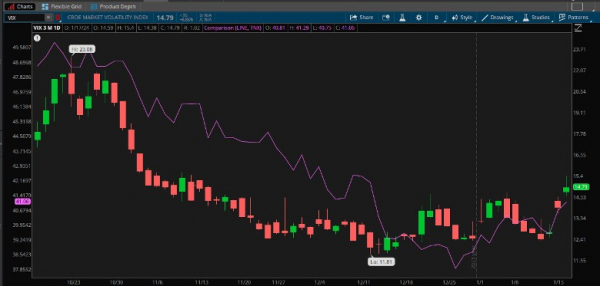
CHART OF THE DAY: FLOCKING TOGETHER: Sometimes it’s hard to say which metric leads the other, but in the case of the U.S. 10-year Treasury note yield (TNX-purple line) and the Cboe Volatility Index (VIX-candlesticks), there’s not much mystery. It seems relatively clear that the recent rise in yields propelled volatility back toward two-month highs after it hit nearly four-year lows late last year. Data source: Cboe. Chart source: The thinkorswim® platform. For illustrative purposes only. Past performance does not guarantee future results.
Thinking cap
Ideas to mull as you trade or invest
Shipping news: Just as inflation seems increasingly under control, the Red Sea crisis raises new pricing concerns. Specifically, shipping rates surged as many ships were forced to avoid the Red Sea and Suez Canal and divert around the Cape of Good Hope. The much longer journey is already contributing to a shortage of freighters heading back to Asia, according to S&P Global. Shipping rates from Asia to the U.S. East Coast jumped more than 50% early this year and many carriers announced surcharges. The Red Sea accounts for 15% of the world’s shipping, and shipping firms are rushing to fill orders before China’s factories shut next month for the Lunar New Year. All this doesn’t necessarily mean a return to the bad old days of the pandemic when shipping chains got snarled for months. There’s an overcapacity of vessels and a more resilient supply chain today, S&P Global notes. Also, the burst of pandemic-related goods demand subsided after COVID-19. Still, keep a close eye on wholesale price trends in the months ahead to see if rising shipping costs put pressure on corporations. “A spike in costs could mean central banks may not be as aggressive in cutting rates in 2024 as the market expects,” Schwab’s Kleintop said. “That could be bad news for stock valuations, especially those that thrive on a flood of market liquidity, like the Magnificent Seven.”
Old nemesis: After playing a big role in the stock market’s 2022 cratering, the U.S. dollar moved to the sidelines in 2023, trading in a tight range near historic norms and not exerting much influence. Two weeks into 2024, investors could wonder if that’s starting to change. To be sure, the Dollar Index remains range-bound near 103.5, but that’s the highest it’s been in more than a month. Investors might be pardoned for thinking they’ve heard this scary dollar talk before after the greenback rallied from below 100 to nearly 107 between last July and October only to relax as investors anticipated rate cuts. For the moment, the dollar draws power from declining odds the Fed trimming rates in March, signs of resilience in the U.S. economy, geopolitical worries that attract investors toward perceived “safety,” and concerns about Chinese and European growth. A higher greenback would likely be bad news for multinational companies with major business overseas. S&P sectors including technology, health care, materials, and industrials are among those with the highest percentage of international revenue. Earnings calls ahead could provide clues on the dollar’s impact.
Chilly forecast: While retail sales surged in December, don’t count on a January repeat. The record cold weather and snow that hit most of the country down to southern Texas could depress shopping this month, even if many people now buy online. Cold weather does play a role, past data show. Last month, retail sales strength glittered in areas like department stores and apparel, suggesting a decent holiday shopping season.
Calendar
Jan. 19: December Existing Home Sales, January Preliminary University of Michigan Consumer Sentiment, and expected earnings from Travelers (TRV), Regions Financial (RF), and Fifth Third (FITB).
Jan. 22: Leading Economic Index (LEI) and expected earnings from United Airlines (UAL).
Jan. 23: Expected earnings from 3M (MMM), D.R. Horton (DHI), Johnson & Johnson (JNJ), Procter & Gamble (PG), Halliburton (HAL), Verizon (VZ), Netflix (NFLX), and Texas Instruments (TXN).
Jan. 24: Expected earnings from Abbott Labs (ABT), Kimberly-Clark (KMB), and IBM (IBM).
Jan. 25: December Durable Orders, December Durable Goods, Q4 GDP, December New Home Sales, and expected earnings from Alaska Air (ALK), American Airlines (AAL), Comcast (CMCSA), Dow (DOW), Union Pacific (UNP), Intel (INTC), and Visa (V).
The Schwab Center for Financial Research is a division of Charles Schwab & Co., Inc.
Charles Schwab & Co., Inc. (“Schwab”) and TD Ameritrade, Inc., members SIPC are separate but affiliated subsidiaries of The Charles Schwab Corporation. TD Ameritrade is a trademark jointly owned by TD Ameritrade IP Company, Inc. and The Toronto-Dominion Bank.


