


Key Takeaways
Market looks ahead to PCE data on Friday
Consumer confidence, existing home sales may give sentiment check
V is for Volatility: With the VIX still around 12, is time growing closer for turbulence?
(Wednesday market open) Considering the holiday weekend ahead, Wednesday’s calendar looks pretty packed. December’s Consumer Confidence reading and November’s Existing Home Sales loom soon after the opening bell today. A couple of U.S. bond auctions also populate the schedule. Then Micron (MU) reports following the close.
Looking back at Tuesday, energy shares extended an early week rally behind a continued rebound in WTI Crude Oil futures (/CL), which rose for a fifth straight day and ended near a three-week high above $74 per barrel. Banks and retailers were also particularly firm. The S&P 500 Retail Select Industry Index (SPSIRE) surged over 2% and ended at its highest level in over 10 months.
The action came amid higher-than-average New York Stock Exchange (NYSE) volume and what appears to be a general lack of selling interest. Small-cap stocks again outperformed the broader market, reflecting a rally that’s gained breadth lately to include slices of Wall Street that missed out on strength earlier this year.
Meanwhile, the benchmark 10-year Treasury yield (TNX) continued to tread water early this week just above 3.9%, reflecting investors’ hopes for easing Fed rate policy and a slowing U.S. economy (and inflation) in 2024. Liz Ann Sonders, chief investment strategist at Schwab, pointed out on X this morning that the two-year Treasury yield was basically unchanged year to date despite trading as low as 3.76% last spring and as high as 5.22% in autumn.
“We expect yields to move lower in 2024 as inflation and the economy cool,” said Cooper Howard, a director of fixed income strategy at Schwab. “We expect three rate cuts next year, but the market is expecting more.”
Barron’s reported that the average 30-year mortgage in the U.S. had a rate of 6.83% hitting a five-month low. Despite the lower rates, housing demand continues to fall.
Morning rush
- The10-year U.S. Treasury Yield (TNX) fell five basis points to 3.884%.The U.S. Dollar Index ($DXY) rose 0.29 points to 104.46.Cboe Volatility Index futures rose 0.25 points before pulling back.WTI Crude Oil (/CL) moved 0.88% higher to 74.59.
What to watch
Consumer Confidence and Existing Home Sales could provide a sentiment check for investors heading into the holidays.
Headline Consumer Confidence from the Conference Board is expected to come in at 104, according to Trading Economics, compared with November’s 102. Keep an eye on the important expectations metric of the report, which at 77.8 in November remained below 80 for a third consecutive month. Historically, anything below 80 signals recession in the next year, the Conference Board said.
Existing Home Sales have cratered over the course of the year due in part to high interest rates but are seen rising slightly to a seasonally adjusted annualized rate of 3.77 million, according to Trading Economics. One school of thought suggests that lower interest rates leading to broader availability of existing homes could loosen real estate inflation to some extent.
Oil traders will be watching the crude oil inventories report after the bell too. The report could help the recent bounce in oil prices or take some air out of it.
Friday’s November Personal Consumption Expenditures (PCE) prices report looms large and the next two days might see some pre-report positioning in the markets. It’s the Fed’s favored inflation indicator and has retreated most of 2023. In October, PCE was flat month over month while core PCE, stripping out energy and food, was up 0.2% month over month and 3.5% year over year. That was an improvement in annual core PCE growth from 3.7% in September.
Improving year-over-year core data could reinforce the idea that the Fed’s more dovish stance is backed by the numbers. Analysts expect monthly core PCE prices to rise 0.2%, the same as in October, Trading Economics says. They see annual core PCE rising 3.3%, down from 3.5% in October. Headline PCE prices are seen at 2.8%, down from 3% last time out, with month-over-month headline PCE prices flat from October.
Don’t overlook the Conference Board’s Leading Economic Index® (LEI) on Thursday morning after the open, either. This report is often seen as a recession barometer, and it’s been flashing red constantly for well over a year. Analysts expect another negative reading for November of –0.3%, according to Briefing.com.
There’s also Thursday’s third and final estimate of U.S. Q3 Gross Domestic Product (GDP) growth. This is a backward-looking number, but analysts might be sharpening their pencils to update Q4 GDP estimates following solid Retail Sales data. Analysts expect Q3 to be unchanged from last time at an annual rate of 5.2%, Briefing.com says.
But wait—that’s not all. Be ready tomorrow morning for weekly Initial Jobless Claims, where the Briefing.com consensus is 218,000, up from the prior week’s two-month low of 202,000. As always, continuing claims may be the more important number to watch for a sense of how tight the job market might be getting.
Stocks in spotlight
FedEx (FDX) reported earnings after Tuesday’s close and shares immediately got run over in premarket trading. The company missed Wall Street analysts’ consensus on earnings per share (EPS) despite matching on revenue and reaffirming prior guidance. The express and freight segments both suffered year-over-year revenue losses. Shares of rival United Parcel Service (UPS) retreated in sympathy. The disappointing results ended a four-quarter streak of FedEx beating analysts’ EPS expectations despite struggling on the revenue front.
Other key earnings this week include Micron Technology (MU) today and Nike (NKE) tomorrow.
Micron’s results could be a chance for investors to get the latest word on how tensions between Beijing and Washington might be affecting Micron’s business. Back in September, Micron referred in its press release to a “weakened near-term supply-demand environment” and said it was taking steps to reduce its supply growth.
Looking ahead to the start of Q4 earnings season in January, research firm FactSet’s 2.4% expectation for Q4 EPS growth is down from its September 30 estimate of 8.1%. The downturn came as many companies guided for weaker results when they reported Q3 earnings.
Eye on the Fed
Early today, futures trading pegged chances at 87.6% of the Federal Open Market Committee (FOMC) holding its benchmark funds rate steady following the FOMC’s January 30–31 meeting, according to the CME FedWatch Tool. The market prices in a 71.1% chance the funds rate will be a quarter point lower after the Fed’s March meeting.
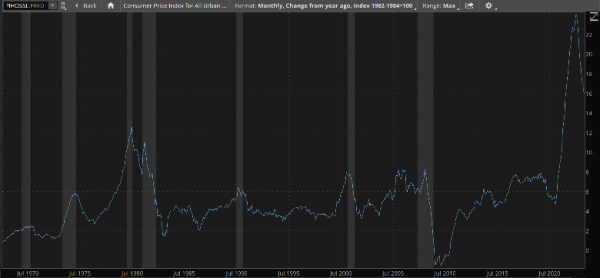
CHART OF THE DAY: HOME SWEET HOME. With the rate of inflation in food and energy slowing drastically, shelter costs continue to be a large driver of the Consumer Price Index (CPI). The CPI average for all urban consumer housing in U.S. cities shows that the rise in shelter costs is slowing but is still at a rate that’s much higher than the last 50-plus+ years. Shelter costs don’t account for housing prices, but it does account for housing payments and rents. If the Fed wants to bring these costs down, it may find it difficult to cut rates. Data source: FRED. Chart source: thinkorswim® platform. For illustrative purposes only. Past performance does not guarantee future results.
Thinking cap
Ideas to mull as you trade or invest
Parked in neutral: One thing keeping U.S. inflation braked is a general softening in vehicle price growth over the last year. Used car prices took another dip last month, the government said in last week’s Retail Sales report, even as shelter costs rose. The pattern of softer vehicle prices isn’t necessarily good news for car company stocks—many of which are down sharply from their 2023 highs—but may represent a tailwind for consumers and helped flatten the Retail Sales trend. Still, the typical person might not notice the impact since most of us don’t buy cars like we buy groceries.
Q4 earnings swim into focus: Negative Q4 guidance from S&P 500 firms is above the five- and -10-year averages, research firm FactSet notes, and analysts project Q4 EPS growth of just 2.4%. That’s followed by expectations for much stronger EPS growth of 11.5% in 2024. The recent forward price-to-earnings (P/E) ratio near 19 for the S&P 500® index (SPX) is up from lows of around 17 last month and on the high side historically, meaning some of the forecast double-digit 2024 earnings growth may already be priced into the market. FactSet’s 2.4% expectation for Q4 EPS growth is down from its September 30 estimate of 8.1%. The downturn came as many companies guided for weaker results when they reported Q3 earnings. Q3, which was the first quarter in a year to see overall earnings rise instead of fall from a year earlier.
So good it’s bad? Stock market volatility is near four-year lows, which can sometimes be a contrarian signal for stocks. The Cboe Volatility Index (VIX) has been scraping around down near 12 recently, near the lowest level since before the pandemic. One thing to keep an eye on is a rise in stocks accompanied by a rise in the stock market. Typically, on days like that, one or the other tends to give back gains. It also might be noteworthy that the S&P financials sector that helped lead the way up in recent weeks turned lower Monday. Signs of a flagging among financials, tech, or other fast-rising sectors could be a sign that investors have begun to worry about the market getting over-stretched. Watch on any sell-off to see if buyers step in below. There’s still a decent amount of money on the sidelines in money market funds.
Calendar
Dec 21: Q3 GDP third estimate, Conference Board Leading Economic Indicators Index, and expected earnings from Nike (NKE).
Dec. 22: November numbers: Durable Goods, Durable Orders, PCE prices, Personal Income, Personal Spending, and New Home Sales. December University of Michigan Consumer Sentiment-Final. November Durable Goods, November Durable Orders, November PCE prices, November Personal Income, November Personal Spending, November New Home Sales, December University of Michigan Consumer Sentiment-Final.
Dec. 25: Markets closed for Christmas.
Dec. 26: December consumer confidence.
Dec. 27: No major data or earnings.
The Schwab Center for Financial Research is a division of Charles Schwab & Co., Inc.
Charles Schwab & Co., Inc. (“Schwab”) and TD Ameritrade, Inc., members SIPC are separate but affiliated subsidiaries of The Charles Schwab Corporation. TD Ameritrade is a trademark jointly owned by TD Ameritrade IP Company, Inc. and The Toronto-Dominion Bank.


