


Key Takeaways
Aviation takes hit after FAA temporarily grounds 737 Max 9 aircraft
Congressional spending agreement could keep shop open—if passed
Backloaded week for data includes inflation and bank earnings
(Monday market open) Welcome to Wall Street’s only Monday in a month, sandwiched between the Christmas, New Year’s, and Martin Luther King Jr. Day holidays. The week begins with many moving parts pulling the market various directions, and most major indexes traded on both sides of the flat line ahead of Monday’s opening bell after a nine-week winning streak ended Friday.
The weekend packed in a lot of news. Boeing (BA) shares tumbled 7% this morning as the Federal Aviation Administration (FAA) temporarily grounded dozens of the company’s 737 Max 9 aircraft after a section of an Alaska Air Group (ALK) plane blew out Friday night. In Washington, D.C., congressional leaders announced a $1.59 trillion spending level that could be the first step in preventing a government shutdown. And overseas, Saudi Arabia cut official selling prices for crude oil, sending crude futures much lower today.
Monday begins with the benchmark 10-year Treasury yield still above 4% after dipping below that late last year. Climbing yields and a firmer dollar both weighed on major indexes last week.
Two U.S. Treasury auctions and a speech by the Federal Reserve’s Raphael Bostic today could have an impact on trading. This comes after Dallas Fed President Lorie Logan said over the weekend that the Fed should slow the pace of balance sheet reduction, which it began nearly two years ago as inflation threatened the economy. The Fed’s balance sheet has shrunk by about $1.3 trillion since mid-2022.
Data-wise, this week is backloaded, with U.S. inflation data and bank earnings set for Thursday and Friday (see more below). We’re coming off the first losing stretch after the longest rally since 2004 for the S&P 500® index (SPX). One question is whether last week’s pattern reversal will continue after investors favored 2023’s beaten-down sectors over the so-called “Magnificent Seven.”
Another question is how to read last Friday’s mixed bag of tidings from the labor market and services sector. December jobs growth far exceeded expectations at 216,000 accompanied by accelerating wage gains, but employment in the services sector cratered, according to the Institute for Supply Management (ISM) Non-Manufacturing PMI released Friday. This yin and yang created a confusing picture that’s still getting sorted through.
Futures based on the SPX were up 0.04% shortly before the close of overnight trading. Futures based on the Dow Jones Industrial Average® ($DJI) fell 0.3%, and Nasdaq-100® (NDX) futures were up 0.2%. Boeing weakness could hurt the $DJI today.
Morning rush
- The 10-year U.S. Treasury Yield (TNX) rose slightly to 4.04%.The U.S. Dollar Index ($DXY) was steady at 102.39.The Cboe Volatility Index® (VIX) inched up to 13.81.WTI Crude Oil (/CL) dropped 3.3% to $71.33 per barrel.
Volatility remains low today, below 14 in the early going, despite weakness in the major indexes and all the looming data. It’s worth watching VIX this week as the market wrestles with so much data and earnings news. Right now, VIX indicates less likelihood of sharp market moves, but we’ll see if that changes going forward.
Just in
Saudi Arabia’s decision to cut the official selling price for its flagship product to Asia was based on rising supplies and competition with rival producers, Reuters reported. Saudi Arabia has been crucial in pushing OPEC production cuts over the last year or two, but that effort has mostly failed thanks in part to heavy U.S. production that kept pressure on prices. Ramifications aren’t immediately clear, but it does bring to mind Saudi Arabia’s 2014 move to hurt rivals that led to an oil price collapse.
From a U.S. perspective, lower prices hurt energy firms but could ease inflation worries.
Over the weekend, Congressional negotiators agreed to an overall government spending number of $1.59 trillion for fiscal year 2024, which began last October 1.
“This is a key development, resolving an impasse that has held up negotiations on the 12 individual appropriations bills for months,” said Michael Townsend, managing director, legislative and regulatory affairs at Schwab. “With an agreed-upon ‘topline’ number, the House and Senate appropriations committees will be scrambling to fill in the agency-by-agency and program-by-program details to keep the government open and operating.”
Several federal agencies would run out of money late next week if funding isn’t passed by then.
“It’s not at all clear, however, that the two chambers will be able to draft, debate and pass the bills before the deadlines, so a government shutdown remains a possibility,” Townsend said.
Jobs report redux: December jobs growth could suggest the market got ahead of itself penciling in as many as six Federal Reserve rate cuts in 2024.
Still, taking into account the government’s downward revisions to October and Novembers data, the economy created an average of just 165,000 jobs over the last three-months, arguably a better way to monitor labor market health than any individual report. The 165,000 figure is well below the 12-month average of 240,000 heading into last Friday’s report, a sign that labor growth continues to slow.
Where things aren’t slowing is wage growth, and that’s the rub. December’s annual hourly wage gains of 4.1% came as good news for workers. However, higher wages can fuel heavy consumer spending that sometimes spikes inflation. The Fed projects three rate cuts this year, and many investors banked on the first one happening in March. That’s not so clear now, but there’s a lot of data before that month’s central bank meeting, including two more jobs reports.
“The growth in wages should lower the likelihood of a rate cut as early as March,” said Collin Martin, a director of fixed income strategy at Schwab. “Average hourly earnings rose by 0.4% in December for the second straight month, and wages rose by 4.1% year over year, its first uptick from the prior month since June. More importantly, on an annualized three-month change basis, wages rose by 4.3%, which is likely too hot for the Fed’s liking.”
ISM Non-Manufacturing PMI immediately following the jobs report soothed market pain, suggesting the hot services sector of the economy might be cooling after fueling inflation much of the last year. Employment in services fell to levels last seen in 2020. Though services overall remain in expansion mode above 50, according to ISM, the drop from November and the soft employment aspect worked against ideas that the Fed might hike rates again.
The futures market now prices in roughly 63% odds of a March rate cut, down from nearly 85% a week ago.
What to watch
Next up: With jobs data behind us, inflation takes pole position as investors brace for the December U.S. Consumer Price Index (CPI) Thursday and the Producer Price Index (PPI) this Friday. Inflation data are under an even more powerful microscope following the robust jobs report. That’s why CPI could be this week’s key market-moving highlight.
Analysts now forecast monthly core CPI for December to rise 0.3% and monthly CPI to climb 0.2%, according to Trading Economics. Core subtracts volatile food and energy prices.
Stocks in Spotlight
The aviation industry pain from Friday night’s incident hit shares of Boeing, Alaska Airlines, and United Airlines (UAL) as investors mulled how the grounding of aircraft might affect scheduling and availability. For Boeing, it’s another dent in the armor following years of trouble with the 737 Max and raises fresh concerns after a relatively quiet stretch that saw shares of Boeing pick up steam in late 2023. Combined, Alaska Airlines and United canceled more than 300 flights Monday due to the grounding.
Big investment banks kick off earnings season Friday as JPMorgan Chase (JPM), Citigroup (C), Bank of America (BAC), and Wells Fargo (WFC) line up at the starting gate, according to Earnings Whispers.
“From a macro perspective, lending standards are still tight, delinquencies are still moving up (though not high relative to history), and consumer credit is still growing at a relatively healthy clip,” said Kevin Gordon, senior investment strategist at Schwab.
Research firm FactSet pegged year-over-year Q4 earnings growth at 1.3% for S&P 500 companies, down from its previous 2.4%, which would mark the second quarter in a row of gains. Analysts expect nearly 12% year-over-year earnings per share (EPS) growth for 2024.
However, there’s some fraying around the edges as just 42% of SPX stocks now trade above their 10-day moving averages. Materials and health care enjoy the best 50-day breadth.
Eye on the Fed
Early today, futures trading pegged chances at 95% for the Federal Open Market Committee (FOMC) holding rates steady following its January 30–31 meeting, according to the CME FedWatch Tool. The market prices in a 63% chance the funds rate will be lower than now after the Fed’s March meeting.
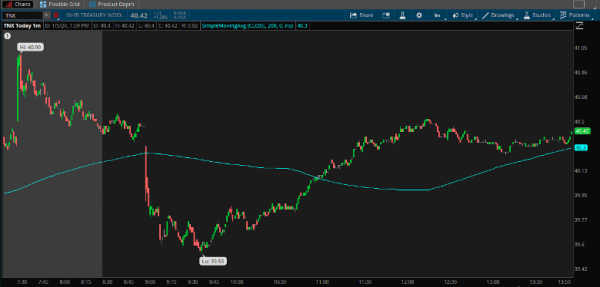
CHART OF THE DAY: FRANTIC FRIDAY: The U.S. 10-year Treasury note yield (TNX-candlesticks) had a dramatic series of highs and lows Friday, climbing sharply in an initial reaction to the jobs report and then descending rapidly not long after on a soft ISM services report. It then finished roughly between the high and low and just above its 200-day moving average near 4% (blue line). Data source: Cboe. Chart source: The thinkorswim® platform. For illustrative purposes only. Past performance does not guarantee future results.
Thinking cap
Ideas to mull as you trade or invest
Breadth check: Though the nine-week SPX winning streak ended Friday amid weakness in the tech sector, U.S. stocks continued to enjoy broader “breadth” than a few months ago, meaning the major indexes aren’t quite as reliant on those same seven names to keep them rallying. About 89% of SPX stocks traded above their respective 50-day moving averages as of Friday, said Joe Mazzola, director, trader education at Schwab. The same is true for 64% of Nasdaq stocks and 77% of Russell 2000® (RUT) stocks.
“Unlucky” seven: The “Magnificent Seven’s” rough 2024 opening helped capsize the SPX’s nine-week win streak. Apple (AAPL), the biggest stock on Wall Street (for the moment) is down 9% from its mid-December peak near $200 per share and is in danger of losing number-one market capitalization status to Microsoft (MSFT). Apple’s week included two analyst downgrades, a New York Times report that the Justice Department could file an antitrust suit against the iPhone manufacturer, and demand worries following Friday’s weak revenue report from major Apple supplier Foxconn Technologies. When Apple shares sour, the SPX often stumbles, not surprising considering Apple alone makes up about 7% of the index’s total value. Apple’s shares finished the old week skimming just above their 200-day moving average of $180, and the direction they go from here could influence the broader market.
Talking technicals: From a technical standpoint, 4,800 likely remains key resistance for the SPX after several efforts to reach it failed in the final week of 2023. It’s also arguably bearish that the small cap RUT slipped below a former key technical level of 2,000. The RUT is often considered a barometer for the broader market and is particularly sensitive to rising interest rates. The RUT is down nearly 6% from recent peaks, a much steeper decline than the 2% SPX drop. Additionally, the Dow Jones Transportation Average ($DJT), a popular barometer of the broader economy, is down 4% from recent highs, again worse than the broader market.
Calendar
Jan. 9: Expected Earnings from Albertsons (ACI).
Jan. 10: November Wholesale Inventories and expected earnings from KB Home (KBH).
Jan. 11: December CPI and Core CPI.
Jan. 12: December PPI and Core PPI and expected earnings from Delta (DAL), JPMorgan Chase (JPM), Bank of America (BAC), Citigroup (C), and Wells Fargo (WFC).
Jan. 15: Market closed for Martin Luther King Day.
Jan. 16: Expected earnings from Goldman Sachs (GS) and Morgan Stanley (MS)
The Schwab Center for Financial Research is a division of Charles Schwab & Co., Inc.
Charles Schwab & Co., Inc. (“Schwab”) and TD Ameritrade, Inc., members SIPC are separate but affiliated subsidiaries of The Charles Schwab Corporation. TD Ameritrade is a trademark jointly owned by TD Ameritrade IP Company, Inc. and The Toronto-Dominion Bank.


