


Key Takeaways
Light trading day expected as investors gear for tomorrow’s CPI data
CPI expected to show continued improvement in annual core rate, analysts say
SEC decision expected soon on exchange-traded funds (ETFs) linked to the spot bitcoin market
(Wednesday market open) Trading could be subdued today as investors step to the sidelines ahead of Thursday morning’s critical U.S. inflation data. Major Wall Street indexes moved sluggishly in overnight trading as the benchmark 10-year Treasury yield continued to pivot around 4%.
Thursday’s December Consumer Price Index (CPI), Friday’s Producer Price Index (PPI), and Q4 earnings from major investment banks loom straight ahead. Analysts expect closely followed core annual CPI—which excludes volatile food and energy prices—to rise 3.8%, down from 4% in November, according to Trading Economics. That would suggest continued improvement and provide further evidence that the Federal Reserve’s pivot toward possible rate cuts might be justified. However, a 3.8% gain would still be well above the Fed’s 2% goal.
“Any upside inflation surprises could pull Treasury yields higher as markets push back their rate cut timing expectations,” said Collin Martin, director of fixed income strategy at Schwab. “But yield increases should be short-lived as we expect the disinflationary trend to ultimately continue.”
In addition, it’s the potential decision day for a new entrant in the cryptocurrency pool: exchange-traded funds (ETFs) linked to the spot bitcoin market. The U.S. Securities and Exchange Commission (SEC) is expected to decide whether to allow spot bitcoin ETFs, which would be a bellwether event for individual investors and crypto itself. The spot market, also known as the cash market, refers to forums where commodities, securities, and other assets can be immediately exchanged between buyers and sellers.
There are thousands of cryptocurrencies, many of which have been trading for several years, as well as a few other ETFs linked to bitcoin futures. But SEC approval of spot bitcoin ETFs listed on established, regulated exchanges, such as the New York Stock Exchange (NYSE), Nasdaq®, and Cboe Global Markets, would potentially open up a new crypto inroad for investors who might otherwise not want to hold actual bitcoin.
A fake post on the SEC’s social media account yesterday announcing approval caused confusion Tuesday afternoon, but Wednesday could bring the actual decision.
Stocks wobbled yesterday as Treasury yields swung higher. Tech stayed in the green but just barely, rising 0.25% to lead all sectors. Only four S&P 500 sectors finished positive Tuesday, and energy fell sharply despite a slight recovery in crude oil prices. Decliners far outnumbered advancers overall, but a few of the so-called “Magnificent Seven” stocks rebounded late in the day.
Futures based on the S&P 500® index (SPX) were up 0.02% shortly before the close of overnight trading. Futures based on the Dow Jones Industrial Average® ($DJI) rose 0.02%, and Nasdaq-100® (NDX) futures were up 0.17%
Morning rush
- The 10-year U.S. Treasury Yield (TNX) fell two basis points to 3.99%.The U.S. Dollar Index ($DXY) is steady at 102.49.The Cboe Volatility Index® (VIX) is steady at 12.89.WTI Crude Oil (/CL) rose slightly to $72.70 per barrel after a dip in U.S. stockpiles.
The 10-year Treasury yield continues to chop around, hugging the 200-day moving average near 4%. December’s plunge below that appeared to ignite additional buying of Treasuries, which move the opposite direction of yields. The 10-year yield finished just above the 200-day moving average yesterday. Tomorrow’s CPI data could help determine where yields go next.
What to watch
Before CPI, the Treasury market might zero in on a 10-year Treasury auction scheduled today. Recent Treasury auctions attracted mixed demand, and signs of flagging interest could propel yields higher in the market. However, results of a 3-year Treasury auction yesterday appeared to impress.
CPI ahead: Inflation comes into sharp focus as investors await CPI and PPI. CPI is due at 8:30 a.m. ET Thursday, and PPI is due at the same time Friday. Inflation data are under scrutiny following last Friday’s robust jobs report and the Federal Reserve’s projections for several 2024 rate cuts. Trading tomorrow morning could be volatile immediately after the open as market participants react to the data, so anyone trading then should approach things with extra caution.
Analysts now forecast monthly core CPI for December to rise 0.3% and monthly CPI to climb 0.2%, according to Trading Economics. Those metrics were up 0.3% and 0.1%, respectively, in November. Core CPI is seen up 3.8% on an annual basis, down from 4% in November, while headline CPI is expected to rise 3.2%, up from November’s 3.1% growth.
Though inflation’s downward trend appears to persist, Fed speakers warned late last year that progress won’t always be linear. That’s something to keep in mind if tomorrow’s data disappoints and the market takes the news badly. The Fed is probably more focused on long-term reads like the six-month inflation trend rather than fixating on specific monthly reports.
Looking ahead to Friday’s PPI, analysts expect smaller price gains, with monthly and core monthly PPI up 0.1% and 0.2%, respectively, and annual headline PPI and annual core PPI up 1.9% and 1.3%, respectively, Trading Economics said. All of these are well below the Fed’s 2% target. PPI tracks wholesale prices, or what companies, not consumers, pay for goods. Because companies often pass higher or lower costs on to consumers, it can sometimes be a helpful barometer of future CPI.
Tracking inflation: For more insight into how to read and interpret this week’s inflation data and to understand the different ways inflation is tracked, check this Schwab video.
Stocks in Spotlight
Big investment banks kick off earnings season Friday as JPMorgan Chase (JPM), Citigroup (C), Bank of America (BAC), and Wells Fargo (WFC) line up at the starting gate. See more below.
Research firm FactSet pegged year-over-year Q4 earnings growth at 1.3% for S&P 500 companies, down from its previous 2.4%, which would mark the second quarter in a row of gains. Analysts expect nearly 12% year-over-year earnings per share (EPS) growth for 2024.
In what could be a positive development for home builder stocks, weekly mortgage applications climbed nearly 10% in the first week of the year, according to the MBA mortgage applications index released this morning. This came despite a slight uptick in average mortgage rates to 6.81%, according to Trading Economics. The surge in mortgage applications was the sharpest one-week rise in a year.
Health care remains the leading sector so far in 2024, up nearly 3%. Utilities and staples are second and third, reflecting possible rotation after tech and communication services led the parade in 2023. Worries about potentially weaker demand continue to hobble those two sectors. Still, volume was lower than average yesterday, which can sometimes hint at a lack of widespread conviction.
Stocks on the move early Wednesday include:
- Shares of Lennar (LEN) rose nearly 2% in premarket trading after the homebuilding company increased its dividend.United Airlines (UAL) shares rose nearly 1% after getting an upgrade from Susquehanna.Home Depot (HD) shares were up about 1% after an upgrade from Wedbush.Intuitive Surgical (ISRG) rose 5.5% after providing guidance for above-consensus Q4 revenue.Juniper Networks (JNPR) rose nearly 1% and Hewlett Packard Enterprise (HPE) was up slightly after the companies confirmed HPE will buy JNPR for $14 billion.
Eye on the Fed
Early today, futures trading pegged chances at 95% for the Federal Open Market Committee (FOMC) holding rates steady following its January 30–31 meeting, according to the CME FedWatch Tool. The market prices in a 64% chance the funds rate will be a quarter-point lower than now after the Fed’s March meeting.
Drilling into jobs: For more insight into last week’s U.S. December jobs report and its possible implications, check out the latest post from Liz Ann Sonders, Schwab’s chief investment strategist, and Kevin Gordon, Schwab’s senior investment strategist. They argue that the report sent mixed signals, with signs of weakness below the robust headline number.
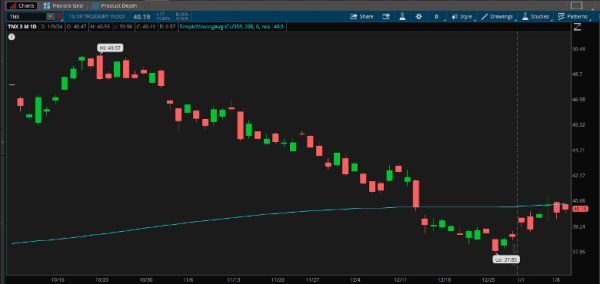
CHART OF THE DAY: HIDE AND SEEK. The closely-watched 10-year Treasury yield (TNX-candlesticks) pressured stocks this week as it climbed back to test its 200-day moving average near 4% (blue line), but remains well below its October high near 5%. Data source: Cboe. Chart source: The thinkorswim® platform. For illustrative purposes only. Past performance does not guarantee future results.
Thinking cap
Ideas to mull as you trade or invest
Mulling bank earnings: When the big banks report, keep an eye on the general level of loan activity and the quality of their existing loans. Though yields are down, banks still have a good deal of outstanding loans on their books due for refinancing this year, and rates are likely to be much higher than when customers took out those loans. This could bring risk of default, or of customers being more cautious about renewing or taking on new debt. The commercial office space market, under a cloud during the financial industry wobbles last spring, isn’t necessarily out of the woods. Another item to watch is loan loss provisions, or the funds that banks put aside in case of loans going bad. These detract from earnings and have been a near-constant drag on bank results since they began adding to them during the pandemic. The question is whether the recent drop in rates, accompanied by economic growth, give big banks a chance to cut back or at least not add to these provisions.
Airlines on tarmac: Airline earnings kick off on Friday with Delta (DAL) after a tough 2023 for the sector and now another hiccup in 2024 with last week’s Alaska Air Group (ALK) incident. That issue weighed on shares of ALK, United Airlines (UAL), and Boeing (BA) early this week. Prior to this new challenge, airlines saw travel demand climb above pre-pandemic levels last year even though shares of the sector trailed the overall market. Several airlines warned in October that the Israel-Hamas war and higher fuel prices could eat into Q4 profits, and earnings season could give investors a chance to see how bumpy the skies became. Delta checks in early; additional big airlines report the week of January 22. Other transport stocks join the mix that week, too, as railroads Union Pacific (UNP) and CSX (CSX) are expected to report following disappointing results from shipping firm FedEx (FDX) in late December. FedEx cited “volatile” economic conditions, and investors might want to see if the railroads reinforce that troubled view.
Yield signs: On the credit side, spreads are low as markets anticipate a “soft landing” and financing is still available for publicly traded firms. When spreads narrow between Treasury and corporate yields, companies generally have an easier time borrowing money. “Nonetheless, we are concerned that credit quality is declining,” said Kathy Jones, chief fixed income strategist at Schwab. That could be something to check on when large investment banks begin to report this week and offer updates on the credit picture. In another yield-related concern, the yield curve remains inverted, historically a sign of recession. An inverted yield curve is when yields on shorter-term Treasuries trade at a premium to yields on longer-term Treasuries. The shorter-term yields are most sensitive to interest rates set by the Fed and may remain elevated until the Fed begins cutting rates. Historically, rate cuts tend to occur during recessions as the Fed tries to stimulate a slow economy. It’s a little less clear how the Treasury market might react if the Fed starts cutting rates while current conditions of falling inflation and steady growth continue.
Calendar
Jan. 11: December CPI and core CPI.
Jan. 12: December PPI and core PPI and expected earnings from Delta (DAL), JPMorgan Chase (JPM), Bank of America (BAC), Citigroup (C), and Wells Fargo (WFC).
Jan. 15: Market closed for Martin Luther King Jr. Day.
Jan. 16: Expected earnings from Goldman Sachs (GS) and Morgan Stanley (MS).
Jan. 17: December Retail Sales, December Industrial Production, expected earnings from Alcoa (AA) and U.S. Bancorp (USB).
The Schwab Center for Financial Research is a division of Charles Schwab & Co., Inc.
Charles Schwab & Co., Inc. (“Schwab”) and TD Ameritrade, Inc., members SIPC are separate but affiliated subsidiaries of The Charles Schwab Corporation. TD Ameritrade is a trademark jointly owned by TD Ameritrade IP Company, Inc. and The Toronto-Dominion Bank.


