


Key Takeaways
December’s U.S. CPI comes in hot, stimulating rate cut timing debate
SEC approves ETFs linked to spot bitcoin, sending cryptocurrency values higher
Friday brings major investment bank earnings, December Producer Price Index
(Thursday market open) The U.S. economy’s progress against rising consumer prices stalled in December, sending Treasury yields higher ahead of the opening bell Thursday as investors contemplated the possible impact on Federal Reserve interest rate policy.
Consumer prices and core consumer prices both rose 0.3%, the government said in its December Consumer Price Index (CPI) report. Core strips out volatile food and energy prices. Analysts had forecast monthly core CPI for December to rise 0.3% and monthly CPI to climb 0.2%, according to Trading Economics. Those metrics were up 0.3% and 0.1%, respectively, in November.
Annual CPI rose 3.4% in December versus 3.1% the previous month, while annual core CPI slowed slightly to 3.9%, from 4% in November. Expectations had been for 3.2% and 3.8% annual CPI and core CPI growth.
Shortly after the report, the futures market downwardly adjusted chances for a quarter-point March Fed rate cut to around 59%, from 64% a day earlier. The Fed last month projected three quarter-point cuts in 2024, but timing is debated. And even after the CPI data, futures prices build in five-to-six rate cuts.
“Bond yields moved higher after the release of the report as a stall in the disinflationary trend could push back the timing of the first Fed rate cut,” said Collin Martin, a director of fixed income strategy at Schwab.
In other news, the Securities & Exchange Commission (SEC) late Wednesday approved exchange-traded funds (ETF) linked to the spot bitcoin market. The spot market, also known as the cash market, refers to forums where commodities, securities, and other assets can be immediately exchanged between buyers and sellers. The move opens up a new crypto inroad for investors who might otherwise not want to hold actual bitcoin and looks like a potential bellwether event for individual investors and crypto itself. ETFs linked to spot bitcoin begin trading today.
Bitcoin rose about 3% in premarket trading to above $47,000. It’s already up 160% over the last 12 months in anticipation of the SEC decision and amid hopes of easing interest rate policy.
Communication services led all of Wall Street on Wednesday and info tech took the silver medal. Strength in tech this week may partly reflect news from this week’s Consumer Electronics show in Las Vegas, with excitement about artificial intelligence driving shares of Nvidia (NVDA) to new record highs. Energy brought up the rear yesterday as crude oil prices stepped back following a large weekly gain in U.S. product stockpiles. Gasoline stocks are the highest for early January in four years, according to the U.S. Energy Information Administration (EIA).
Futures based on the S&P 500® index (SPX) were down 0.2% shortly before the close of overnight trading. Futures based on the Dow Jones Industrial Average ($DJI fell 0.7%, and Nasdaq-100® (NDX) futures were up 0.09%.
Morning rush
- The10-year U.S. Treasury Yield (TNX) rose three basis points to 4.05% after the CPI data.The U.S. Dollar Index ($DXY) was steady at 102.4.The Cboe Volatility Index® (VIX) was flat near 12.6.WTI Crude Oil (/CL) rose about 2% to $72.90 per barrel amid renewed Middle East tensions.
Just in
Despite the market’s disappointment over today’s CPI report, there was some progress. For instance, the 3.9% annual core growth was the first one since mid-2021 to fall below 4%. Also, high shelter prices accounted for more than half of the headline CPI figure, and that’s been a long-term issue that wasn’t unexpected.
Higher energy and food prices helped lift the non-core CPI readings, tough news for consumers.
Fed speakers warned late last year that inflation progress won’t always be linear. The Fed is probably more focused on long-term reads like the six-month inflation trend rather than fixating on specific monthly reports. Still, the December CPI bump likely supports thinking that the market might have gotten ahead of itself dialing in rate cuts as soon as March.
“We’ve long thought a March cut would be too aggressive, and we think the first cut should come by mid-year,” Schwab’s Martin said. “Bond investors should still consider intermediate- or long-term bonds now, even with them down sharply from their peak, since they should eventually trend lower. Investors who have been parked in short-term investments should be prepared to see lower yields as those rate cuts come to fruition.”
Meanwhile, weekly Initial Jobless Claims remained tame at 202,000, the lowest since the second week of October last year. Continuing claims stayed under 1.9 million. The data imply that layoffs remain rare.
What to watch
Looking ahead to Friday’s Producer Price Index (PPI) for December, analysts expect monthly and core monthly PPI up 0.1% and 0.2%, respectively, and annual headline PPI and annual core PPI up 1.3% and 1.9%, respectively, Trading Economics said. All of these are below the Fed’s 2% target. PPI tracks wholesale prices, or what companies, not consumers, pay for goods. Because companies often pass higher or lower costs on to consumers, it can sometimes be a helpful barometer of future CPI.
PPI reports haven’t moved the market as much as CPI data have recently, but you can’t rule out a market reaction if tomorrow’s report is particularly bullish or bearish. Still, PPI competes with the start of earnings season, giving it a built-in disadvantage. Data sometimes takes a back seat to earnings during the heart of corporate reporting season, or its impact can be slightly blunted.
Stocks in spotlight
Big investment banks kick off earnings season Friday as JPMorgan Chase (JPM), Citigroup (C), Bank of America (BAC), and Wells Fargo (WFC) line up at the starting gate. Provisions for loan defaults, guidance for the year ahead, and deposit trends all crowd for attention. So do the banks’ perceptions of credit quality and demand, which could help determine how difficult or easy it is for businesses to borrow in coming months.
“The bank earnings are important because they are a barometer on the overall economy and help set the tone for the earnings season,” said Nathan Peterson, director of derivatives analysis at the Schwab Center for Financial Research. “We’ve seen Q4 earnings growth estimates come down over the past several months, which calls into question one of the pillars to the bulls’ theses: expectations for double-digit earnings growth in 2024. Now, we need to see evidence that the thesis is correct.”
Delta Airlines (DAL) and United Health (UNH) are also expected to report Friday.
Friday’s bank earnings and PPI data precede a long weekend, with U.S. markets closed Monday for the Dr. Martin Luther King Jr. holiday.
Stocks on the move early Thursday include:
- Salesforce (CRM) climbed 1% after getting an analyst upgrade from Robert W. Baird.Chewy (CHWY) is up 2% on an upgrade from Barclays.KB Home (KBH) fell 3% despite earnings late Wednesday beating Wall Street’s consensus views. Weakness in gross margin due to falling home prices might be weighing on shares.Hertz (HTZ) fell 2% after guiding for slightly lower Q4 revenue than Wall Street had expected and deciding to sell about one-third of its global electric vehicle fleet, or approximately 20,000 vehicles.
European and Asian equity indexes traded mostly higher overnight, with Japan’s Nikkei closing above 35,000 for the first time since 1990. A weaker yen that could help Japan’s exporters and less concern about a possible Bank of Japan (BoJ) rate hike supported shares there, according to Reuters.
Eye on the Fed
Early today, futures trading pegged chances at 99% for the Federal Open Market Committee (FOMC) holding rates steady following its January 30–31 meeting, according to the CME FedWatch Tool. The market prices in a 59% chance the funds rate will be a quarter-point lower than now after the Fed’s March meeting. That’s down from 64% yesterday before the CPI report.
Risky business: The top-five upside and downside global risks to base-case expectations for 2024 are lingering inflation, rate hikes offsetting rate cuts, China rebounding, artificial intelligence (AI) productivity boosts, and election surprises, said Jeffrey Kleintop, chief global investment strategist at Schwab. His recent column dives into each risk individually and discusses their possible market impact.
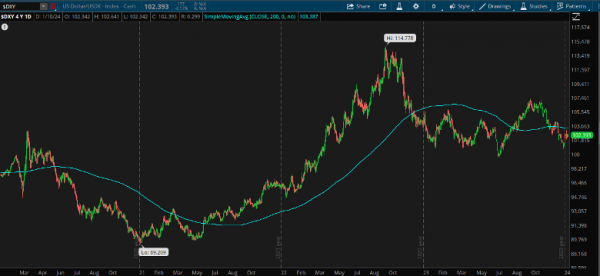
CHART OF THE DAY: DOLLAR CALM EXTENDS. The U.S. Dollar Index ($DXY-candlesticks) traded in a tight range most of 2023, near its 200-day moving average (blue line) and started 2024 in the same vein. This four-year chart shows how the dollar descended in 2020 as the Fed cut rates and then climbed dramatically in 2022 as rates tightened. Though the dollar is down from last fall, it hasn’t responded much to the Fed’s 2024 rate cut projections delivered a month ago. It now trades just where it was before the Fed’s last meeting. Data source: ICE. Chart source: The thinkorswim® platform. For illustrative purposes only. Past performance does not guarantee future results.
Thinking cap
Ideas to mull as you trade or invest
Breadth charge: A broadening of market breadth over the past few weeks soothed those who worried last year about the “Magnificent Seven” outgaining almost everyone else. Investors recently put money to work in 2023’s less loved sectors like staples, utilities, and health care. Financials also got a bid. This week’s action, so far, went against that grain as a handful of mega-caps, including Microsoft (MSFT) and NVDA, traded near or set new all-time highs. “Last week we saw rotation into the underperforming sectors and some modest consolidation, but that appeared to have reversed, with technology being the best performing sector so far this week,” said Schwab’s Peterson. “The question is whether or not last week’s pullback was enough of a consolidation move.”
Even so: Despite tech’s gains this week, market breadth appears healthier than in the recent past. “For all the concern that equities’ weak start this year resembles other years with bear markets, like 2022, key to keep in mind is that breadth is stronger this time around,” said Kevin Gordon, senior investment strategist at Schwab. “Sentiment is still quite stretched—both on the attitudinal and behavioral side—which means that the market remains vulnerable to a correction. However, the backdrop—whether it’s the number of stocks trading above their 200-day moving average, outperforming their respective benchmark, or in an uptrend—is relatively healthy. That keeps the broader uptrend in place, albeit not perfectly or smoothly.” As of late Wednesday, 84% of S&P 500 stocks traded above their respective 50-day moving averages, with only the energy sector lagging in that category.
Credit check: When large investment banks and smaller regional banks begin reporting Friday and next week, the focus on credit quality could be heavier than usual. That’s because in some respects, the quality of credit could help guide the Fed as it contemplates rate policy. The Bloomberg U.S. Financial Conditions Index is near its most accommodative level since early 2022, before the Fed embarked on its most aggressive rate hike campaign in decades. “Despite a Fed funds rate near 5.5%, falling Treasury yields, falling credit spreads, and rising stock prices are all contributing to the easing of conditions,” noted Schwab’s Martin. “The Fed will be paying close attention to financial conditions since a premature cut could ease conditions even more and allow inflationary pressures to build.” The Fed noted in its December meeting minutes that easing financial conditions have already reversed some of the tightening that existed previously.
Calendar
Jan. 12: December PPI and core PPI and expected earnings from Delta (DAL), JPMorgan Chase (JPM), Bank of America (BAC), Citigroup (C), and Wells Fargo (WFC).
Jan. 15: Market closed for Martin Luther King Jr. Day.
Jan. 16: Expected earnings from Goldman Sachs (GS) and Morgan Stanley (MS).
Jan. 17: December Retail Sales, December Industrial Production, expected earnings from Alcoa (AA) and U.S. Bancorp (USB).
Jan. 18: December Housing Starts and Building Permits, expected earnings from J.B. Hunt (JBHT), Northern Trust (NTRS), and M&T Bank (MTB).
The Schwab Center for Financial Research is a division of Charles Schwab & Co., Inc.
Charles Schwab & Co., Inc. (“Schwab”) and TD Ameritrade, Inc., members SIPC are separate but affiliated subsidiaries of The Charles Schwab Corporation. TD Ameritrade is a trademark jointly owned by TD Ameritrade IP Company, Inc. and The Toronto-Dominion Bank.


